The Small-World Science Behind Every Wiki Race
Published on 2026-09-12
A few months back I got paired against a stranger in a ranked duel: start article "Ganesh Chaturthi," target "Large Hadron Collider." I remember thinking the match was basically decided before either of us clicked once. A Hindu festival and a particle accelerator don't share much, on the surface. My opponent finished in four clicks. I finished in five, annoyed the whole time that it hadn't taken longer.
That's not a fluke, and it's not really about clever players either. It's a property of the network itself. It has a name, a real research history, and a reason it works on almost every pair you can throw at it, not just the ones that look easy.
The experiment that gave the phenomenon its name
In 1967, psychologist Stanley Milgram ran an experiment that had nothing to do with encyclopedias. He handed out folders to people in Omaha, Nebraska and Wichita, Kansas, and asked them to get each one to a specific stockbroker in Boston, not by mailing it directly, but by passing it to someone they knew on a first-name basis, who'd pass it to someone they knew, and so on, until it reached the target. The folders that made it averaged around six intermediaries. "Six degrees of separation" comes directly from that study.

Milgram wasn't studying Wikipedia. Wikipedia didn't exist for another 34 years. But the underlying question is identical to the one WikiRacing asks every time you hit start: in a network this size, how far apart can two things really be?
What actually makes a network "small"
Milgram's result stayed a curiosity for decades until 1998, when Duncan Watts and Steven Strogatz gave it a mathematical backbone. Their paper in Nature described what they called small-world networks: graphs that combine two properties that shouldn't, intuitively, go together. First, most nodes cluster into tight local neighborhoods; your friends mostly know each other. Second, despite that clustering, the average distance between any two nodes stays surprisingly short. A handful of long-range connections is enough to collapse a huge network down to a few short hops.
Wikipedia's link structure fits that description almost too well. Articles cluster by topic (biology pages link mostly to other biology pages, footballers to other footballers), but scattered throughout are links that jump straight across categories: a biography that mentions a war, a chemical that mentions an industry. Those cross-category links are the "long-range" connections Watts and Strogatz described, and they're exactly what makes a pair like Ganesh Chaturthi and the Large Hadron Collider solvable in single digits instead of dozens of clicks.
Why a handful of pages hold the whole thing together
Clustering plus occasional long jumps explains short paths existing somewhere. It doesn't explain why the same handful of pages (country articles, decades, major scientific fields) keep showing up as the shortcut, race after race. For that you need a second piece of network theory, published by Albert-László Barabási and Réka Albert in 1999.
Their model describes what's called a scale-free network, and the mechanism behind it is almost insultingly simple: new nodes preferentially attach to nodes that are already well-connected. A new Wikipedia article about a 2020s pop song is far more likely to link to "United States" than to some other song from 1994, not because of any rule saying it should, but because "United States" is already the kind of article every editor reaches for. The rich get richer. Run that process over twenty-plus years and millions of articles, and you get exactly what WikiRacing players learn to exploit: a small set of hub pages holding a wildly disproportionate share of the incoming links.
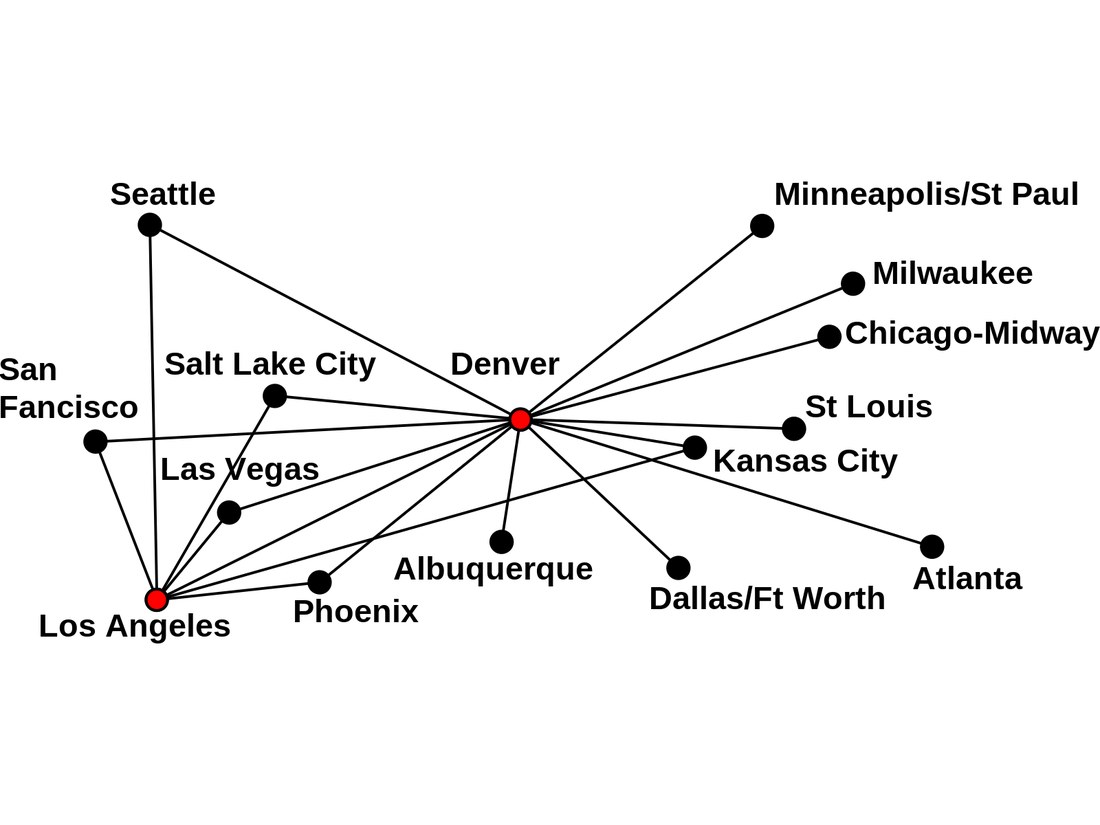
Airline networks work the same way, for the same reason, and it's a useful way to picture what's happening. Nobody flies Missoula to Tallahassee directly; you connect through Denver or Atlanta because it would be absurd for every small airport to have a direct route to every other small airport. Wikipedia editors never sat down and designed "France" or "World War II" to be hub articles on purpose. They became hubs the same way Denver became a hub: once a node is well-connected, linking to it is simply the path of least resistance for whoever writes the next article.
Researchers actually watched people do this
This isn't just theory bolted onto a game after the fact. In 2012, Stanford researchers Robert West and Jure Leskovec studied more than 30,000 real human attempts at exactly this kind of race, using a research tool called Wikispeedia, a stripped-down, offline version of Wikipedia built specifically to study how people navigate between articles with no map of the network and no idea what's coming next.
What they found matches what most experienced WikiRacing players will tell you if you ask: people don't try to plot a direct route up front. They jump toward a general, well-connected article first, something with a lot of outgoing links, and only start narrowing in on the actual target once they're in the right neighborhood. West and Leskovec's data backs this up quantitatively: players systematically favor high-degree pages early in a race, then switch to content-matching once they're closer. It's not a trick invented by fast players. It's the correct response to how the network is actually shaped, and most people arrive at it on instinct within a few games.
The weird proof hiding in plain sight
There's a separate, almost accidental demonstration of the same underlying structure, and it's one you can try yourself without playing WikiRacing at all. Open any English Wikipedia article, click the first link in the body text (ignoring anything in parentheses or italics), then repeat that on whatever page you land on. Keep going.
Do this enough times and, more often than not, you end up at "Philosophy." A 2016 survey of the phenomenon found it held for about 97% of English Wikipedia articles, up from roughly 94.5% measured in an earlier 2011 pass. The rest loop forever, hit a dead end, or land on a page with no first link at all. The average chain length under that specific rule runs to around 23 clicks, which tells you something important: this isn't the same thing as a WikiRacing shortest path. Nobody's claiming Philosophy is a good target in-game. What it does prove is that Wikipedia's link graph funnels toward a small set of extremely general, foundational articles even when you're not trying to steer it there at all, the same underlying gravity that makes deliberate hub-hopping so effective when you are trying.
What this actually means at the keyboard
None of this requires you to remember Milgram's name or explain preferential attachment to anyone mid-race. But it does mean the beginner instinct (try to find a direct link, get frustrated when there isn't one, keep clicking through specific, narrow articles hoping to stumble onto the answer) is fighting the actual shape of the network instead of using it. Our list of the twenty hub articles worth knowing gives you the practical shortlist; this is the reason that shortlist works at all, and why it'll keep working on pairs nobody's thought to add to it yet.
The next time a pair looks impossible before you've clicked anything (a bread and a public health crisis, a religious festival and a particle accelerator), remember that "impossible-looking" and "actually far apart" are two different claims. On a small-world network with a handful of well-placed hubs, they're almost never the same thing.
More articles
What Is a Wiki Race? The Full Guide to Wikipedia's Favorite Browser Game
What a "wiki race" actually is, where the idea comes from, and how to play one: from a two-minute manual race to a ranked duel or a 300-level campaign.
How Big Is Each Wikipedia? Ranking WikiRacing's 19 Languages by Article Count
From English's 7+ million articles down to Czech's under 600,000: how WikiRacing's 19 Wikipedia editions actually compare in size, and what that gap does (and doesn't) change about the race.
Wikipedia Rabbit Holes: 7 Wild Facts You Stumble Into by Clicking Around
Cleopatra is closer to the Moon landing than to the Great Pyramid, and six more surprising facts hide a few clicks deep in Wikipedia: the same kind of detours WikiRacing throws at you.