The History of Wikipedia Racing Games
Published on 2026-08-02
A few years back I opened the Wikipedia article on bread to settle an argument about sourdough, and twenty minutes later I was reading about the Battle of Verdun. I still haven't figured out the exact path that got me there.
That kind of detour has had a name for a lot longer than any game has been built around it. Its history (from hallway joke to real-time ranked competition) explains a good chunk of what WikiRacing is actually trying to do, and why some fairly obvious ideas took twenty years to land in the same place.
A joke before it was a game
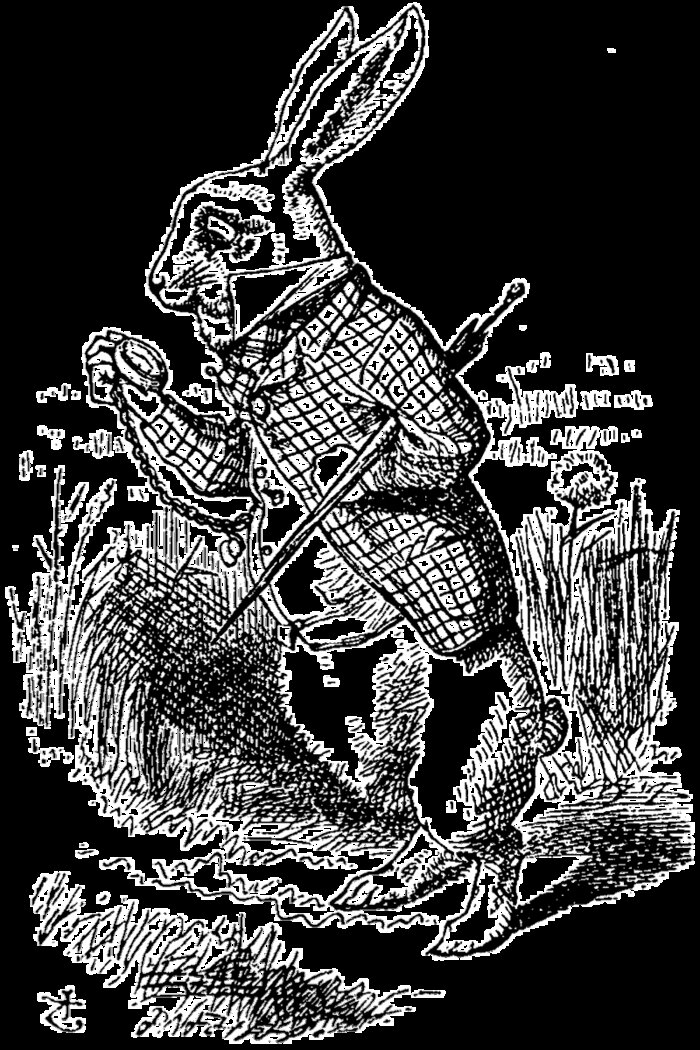
The term "rabbit hole," borrowed from Alice in Wonderland, was already circulating on forums long before any game was built around it. It describes a very specific feeling: starting on one targeted topic and ending up, several clicks later, somewhere completely unrelated without ever deciding to go there. People shared their most absurd click trails the way you'd share a good joke: started on a kitchen appliance, landed on a medieval war, three clicks flat.
That's not an accident of design. Wikipedia's own style guidelines actively push editors to link related concepts wherever it helps a reader, which mechanically turns the whole encyclopedia into a dense graph instead of a flat pile of pages. An article about a composer links out to their era, their hometown, their instrument, their students; each of those links opens a dozen more doors. A racing game built on top of that was, in hindsight, only a matter of time.
When Stanford researchers took the joke seriously
The first structured format to come out of that shared observation wasn't built for entertainment at all. In 2009, researcher Robert West, along with Joelle Pineau and Doina Precup, presented Wikispeedia at IJCAI: a tool built to study how humans navigate large information networks, not to amuse anyone on a Saturday night.
The rule itself was simple enough: connect two articles from a condensed version of Wikipedia, roughly 4,600 pages, using only internal links, in as few clicks as possible. The goal, though, was academic top to bottom. Stanford ended up hosting the resulting dataset: more than 76,000 games played between 2009 and 2014, boiled down to about 51,000 valid paths across nearly 29,000 distinct missions. Those numbers are still cited today in web navigation and information-retrieval research, which is a pretty solid track record for a project that never once tried to be a "game" in the fun sense.
Wikispeedia had no live leaderboard, no opponents, no content that kept evolving. Just a fixed map, explored once and then set aside by most casual players once the curiosity wore off. But the project proved something real, almost by accident: the core mechanic, stripped of any game-like packaging, was interesting enough to keep researchers occupied for five straight years.
The solver that refuses to play
Another project is worth a mention here, if only as a contrast: Six Degrees of Wikipedia, built by developer Stephen Dolan. Its point isn't to make you play anything. It's to instantly calculate, via a bidirectional Dijkstra search, the shortest path between any two articles among the roughly seven million on English Wikipedia. Usually in six steps or fewer. Often a lot fewer.
It's a genuinely fascinating tool to try once, almost hypnotic to watch run. But it quietly shows what separates a solver from a game: nobody gets a rush of excitement watching an algorithm compute an optimal path. The appeal of the rabbit hole comes specifically from the fact that you're the one searching, not a machine handing you the answer in a few milliseconds.
The game most people actually played
It was The Wiki Game, started by developer Alex Clemesha back in 2010, that pulled the idea out of the academic world and turned it into an actual mainstream hobby. No research agenda, no fixed dataset. Just two articles, a path to find, and a score to compare with friends. The site took nearly a decade to really take off; its traffic exploded mainly around 2019, and then again during the Covid-19 lockdowns, right as a lot of people were looking for exactly this kind of short, free, nothing-to-install distraction.
Unlike Wikispeedia's frozen dataset, The Wiki Game browses the live Wikipedia directly. And that changes everything: a path that worked last week can vanish overnight if an editor rewords a sentence or trims a link that's grown redundant. The encyclopedia itself becomes a moving target. Oddly enough, that's a big part of what makes it worth replaying: no two attempts at the same pair of articles ever play out guaranteed identically.
This is also roughly when real slang started forming spontaneously across player communities: "hub article" for the heavily-connected pages everyone keeps trying to route back through, "dead end" for the article that leads nowhere useful, and of course "rabbit hole" itself, graduating from in-joke to genre terminology.
What every one of these versions was still missing
None of these formats, clever as they were, ever offered a real opponent racing you in real time. At best, an asynchronous leaderboard: you see your score, maybe compare it to a global list, and that's roughly it. WikiRacing started from that exact gap. Up to five players in the same real-time race, with a live HUD showing everyone's progress click by click; an ELO ranking system modeled on chess and esports, where only a strict 1v1 ranked duel actually moves the number; a 300-level solo campaign with rising difficulty; and a daily challenge that hands the entire community the exact same pair of articles, every single day, across all 19 of the site's languages.
That last part actually changes what a comparison between two players means. On The Wiki Game or Wikispeedia, comparing your score to a friend's never really made sense: you'd almost never played the same pair of articles at the same time. The daily challenge removes that excuse entirely: everyone starts from the same point, heading to the same target, on the same day, and the resulting leaderboard finally compares runs that are actually comparable.
Nineteen Wikipedias, not one
Here's the part that surprises most new players: WikiRacing runs across 19 languages, and each one navigates its own edition of Wikipedia, not an English translation reskinned into another language. A French player and a Japanese player facing off in a ranked duel aren't looking at the same map at all. Each one has their own link graph, their own hub articles, their own dead ends, while still competing on the exact same ELO pool and global leaderboard.
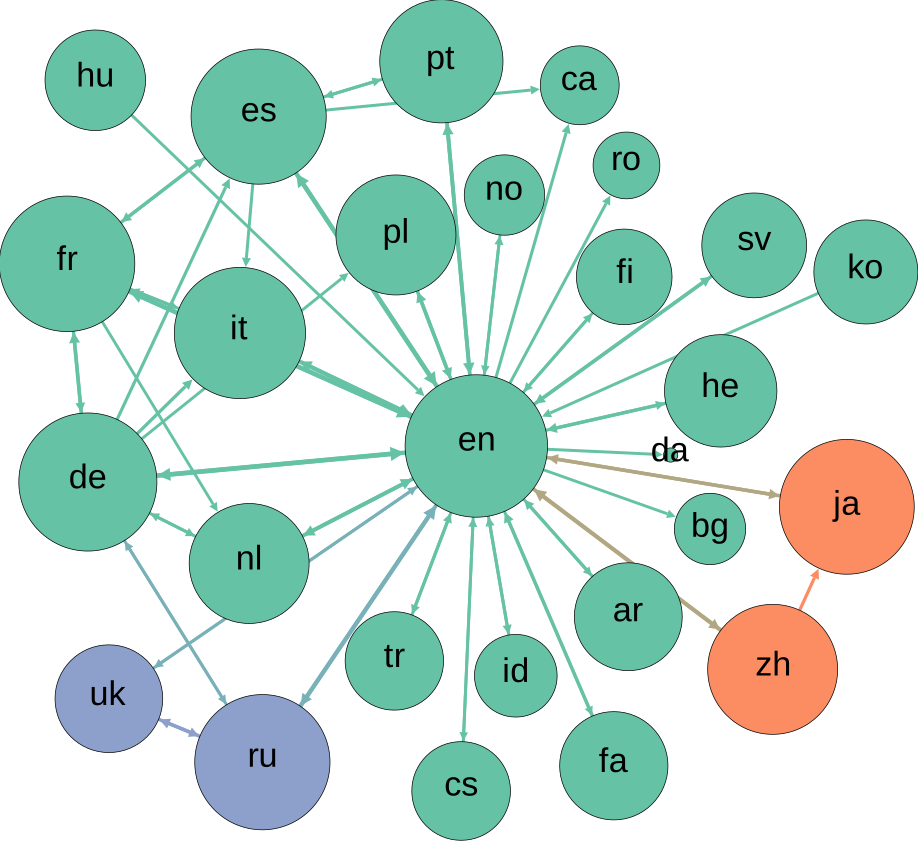
This graph, built from cross-language editor overlap, makes the point fairly well without even mentioning games: Wikipedia's 300-plus editions aren't carbon copies of each other. Each one has its own link density, its own over-developed topics, its own blind spots. That structural difference is exactly what makes a multilingual race more interesting than the same game reskinned in eleven different outfits. Japanese and French simply don't reward the same navigation instincts.
Still the same rabbit hole, twenty years on
Step back and look at the whole lineage, and one thing stands out: nobody ever needed to change the core rule. Two articles, links, a path to find: that's it, unchanged since some curious reader's first accidental detour in the early 2000s. What changed is everything around it: a frozen research snapshot for five years, then a browser game against a living, shifting Wikipedia, then, today, a live race room with five players, an ELO leaderboard, and a community spread across 19 languages all watching the same scoreboard update in real time.
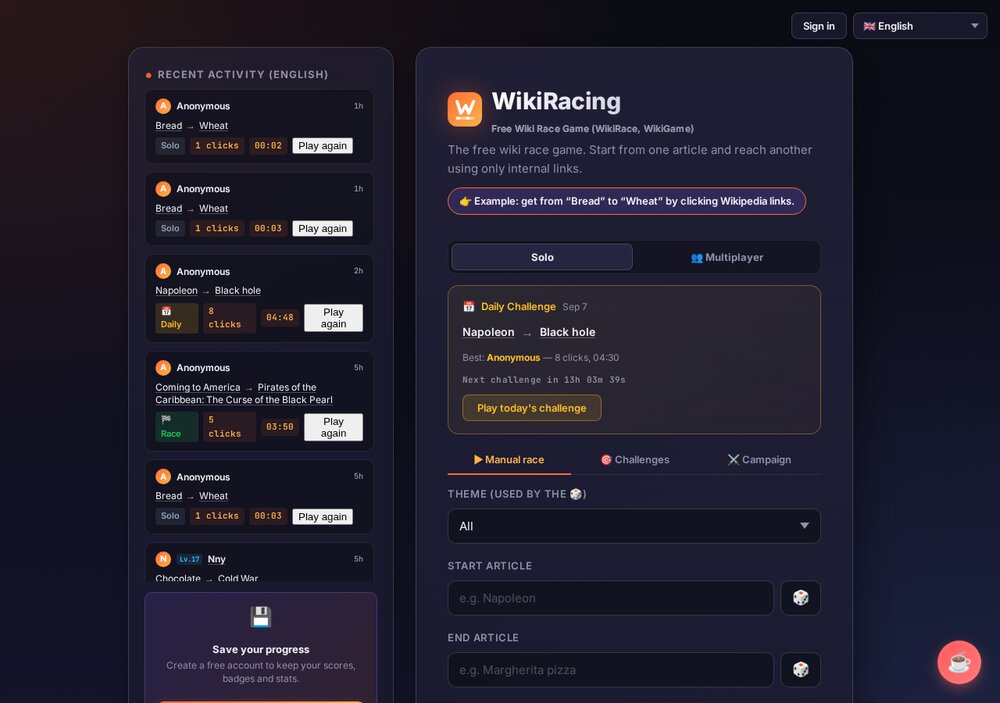
The rabbit hole never really changed shape. It just eventually found some opponents.
More articles
What 205,000 Real Clicks Reveal About Wikipedia's Busiest Articles
Measured from 27,792 finished races across 19 Wikipedia editions: every language routes through its own country and the United States, 100 articles carry a seventh of all traffic, and the only truly universal connectors are brand names.
What WikiRacing Has in Common With Speedrunning Culture
Pair leaderboards, a campaign you can memorize, a daily challenge with the same pair for everyone: an honest comparison between WikiRacing and video game speedrunning culture.
The Small-World Science Behind Every Wiki Race
Milgram, Watts-Strogatz, Barabási-Albert: the real network theory behind why almost any pair of Wikipedia articles resolves in a handful of clicks.